Escrito por The StreamYard Team
Streaming Software for Screen Capture: How to Choose (and Why Most People Start with StreamYard)
Last updated: 2026-01-10
For most people in the U.S. who want to share their screen on a live stream or recording, the easiest path is to use StreamYard’s browser-based studio for quick screen sharing and in-studio video playback. If you specifically need complex, local 4K/60fps display capture with deep scene control, desktop tools like OBS or Streamlabs can complement (or feed into) that setup.
Summary
- StreamYard is a fast, browser-based way to share your screen and play back videos without installing software; guests can share screens too. (StreamYard Help Center)
- OBS and Streamlabs give you detailed local screen capture (whole display, windows, or games) and are better suited for highly customized gaming or production scenes. (OBS Knowledge Base) (Streamlabs Support)
- Restream’s browser studio offers multi-destination streaming with screen share and audio from desktop browsers, but you still manage more complexity than a single, focused studio. (Restream Help)
- For most non-technical hosts, StreamYard balances quality, ease of use, multi-guest support, and advanced features like 4K local recording and AI clips in one workflow.
What does “streaming software for screen capture” actually mean?
When people search for "streaming software for screen capture," they’re usually trying to do one of a few things:
- Share a slide deck or browser tab while presenting live
- Walk through a product demo or tutorial
- Stream a gameplay session or creative app window
- Record their screen with camera and mic for replay later
You need two ingredients:
- Screen capture – grabbing your display, a window, or a browser tab.
- Streaming studio – sending that capture (plus your camera, mic, overlays, etc.) to platforms like YouTube, Facebook, LinkedIn, or Twitch.
Some tools combine both in one place; others split them:
- StreamYard: browser-based studio that lets hosts and guests share screens directly, plus play full video files from within the studio. (StreamYard Help Center)
- OBS / Streamlabs: desktop apps that specialize in local capture (displays, windows, games) and output a stream.
- Restream: cloud multistream platform with its own Studio that adds screen share and audio capture from desktop browsers. (Restream Help)
For most mainstream needs—webinars, tutorials, coaching calls, live launches—the studio experience and guest workflow matter more than ultra-precise encoding tweaks. That’s why we generally recommend starting in a browser-based studio like StreamYard and layering in heavier tools only if you actually hit their limits.
How does StreamYard handle screen capture for live streams and recordings?
StreamYard is built around a simple idea: run your whole show in the browser, invite people with a link, and control what’s on screen with a few clicks.
Screen sharing in the studio
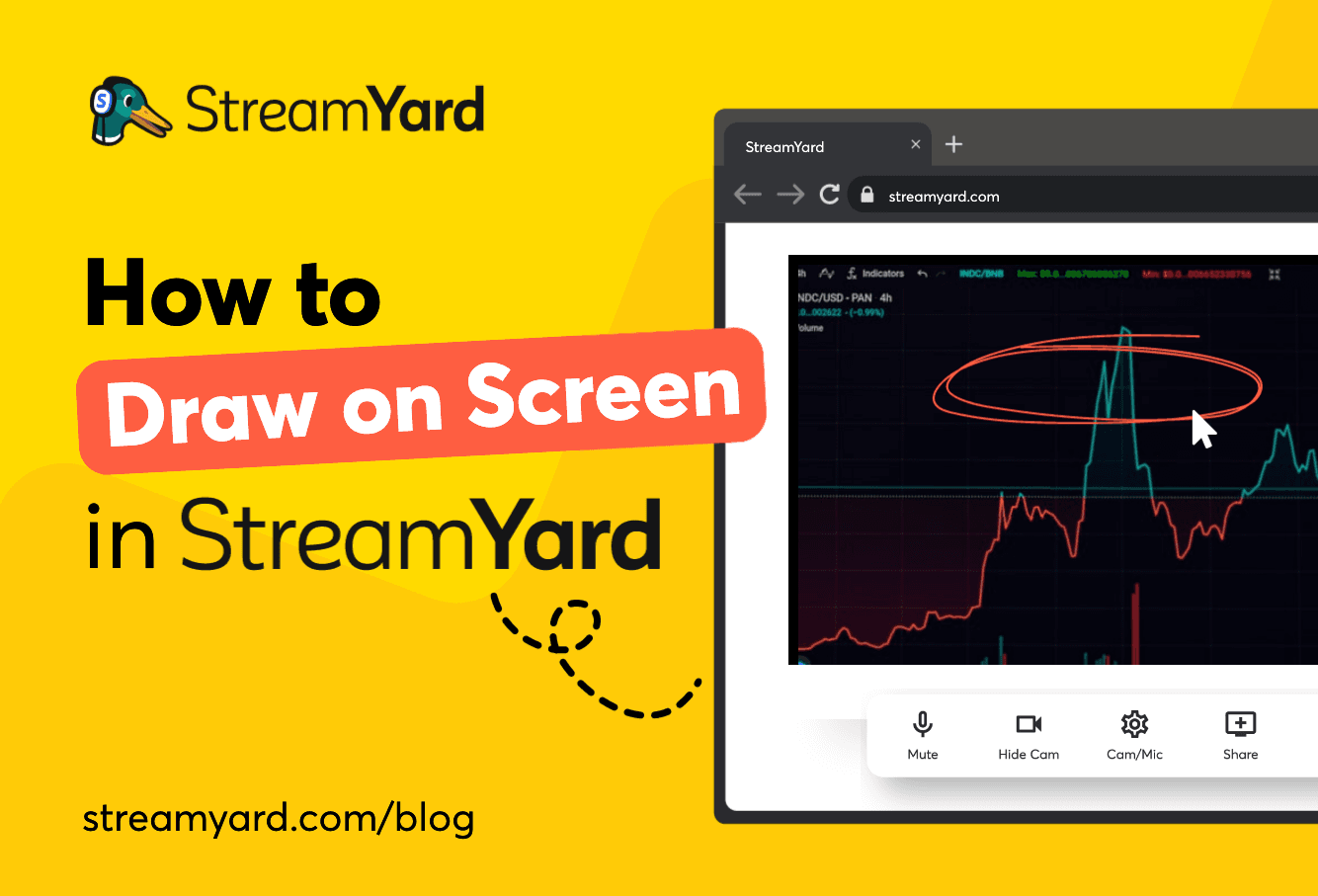
In StreamYard, both the host and guests can share their screens while you’re live or recording. The studio lets you easily switch between camera, shared screens, and preloaded assets so your viewers see a polished sequence instead of chaotic window juggling. (StreamYard Help Center)
You can:
- Share your entire screen, a specific window, or a browser tab.
- Combine a shared screen with on-camera hosts and guests in different layout templates.
- Put overlays, lower-thirds, and logos on top of your screen share so it looks like a produced show instead of a raw screenshare.
From a viewer’s perspective, this is the difference between “I’m just sharing my screen on a call” and “I’m watching a live program.”
Sharing screen with audio (the Chrome tab detail)
When you want to play embedded video or audio from your computer, the details matter. In StreamYard, screen sharing with audio is supported by sharing a Chrome tab, which pipes the tab’s audio directly into the stream. (StreamYard Help Center)
In practice, the workflow looks like:
- Open your video or audio in a Chrome tab.
- Choose "Share screen" in the studio.
- Pick "Chrome tab" and check the audio box.
This gives you clean, reliable audio without complicated virtual audio cables or driver tweaks—exactly the kind of complexity many creators want to avoid.
Long-form video playback from files
Beyond raw screen sharing, StreamYard lets you upload long-form video files and play them directly from the studio. The long-form video feature is available on all plans and is not limited by a stated file size or length cap, so you can load up full-length webinars, trainings, or pre-produced segments for smooth playback. (StreamYard Help Center)
This matters if, for example, you want to:
- Play a polished demo video, then come on camera for live Q&A.
- Run a pre-recorded training as if it were live, while you and your co-hosts interact in the chat.
4K local recording and AI repurposing
If you care about content that lives beyond the live moment, StreamYard supports studio-quality multi-track local recording in 4K UHD, with audio recorded at a 48 kHz sample rate—on par with dedicated remote recording tools. On top of that, AI clips can automatically scan your recordings and generate captioned shorts and reels, with the option to regenerate clips based on a text prompt so you can steer the AI toward specific themes.
Combined with screen sharing, this means you can:
- Run a live tutorial or webinar.
- Capture high-quality 4K local tracks for post-production.
- Quickly create short, vertical clips of the best screen moments for social.
For most small teams and solo creators, that’s the entire lifecycle—from live screen share to evergreen content—without ever leaving the studio.
How does StreamYard compare with OBS, Streamlabs, and Restream for screen capture?
Let’s walk through how the main options approach screen capture and where StreamYard typically makes the most sense.
OBS: deep control for local capture and complex scenes
OBS Studio is free, open-source software used for both live streaming and screen recording. It runs on Windows, macOS, and Linux, and gives you a scene-based workflow with layers, transitions, and detailed encoder control. (OBS Project)
For screen capture specifically:
- Display Capture lets you capture your entire monitor. (OBS Knowledge Base)
- Window Capture grabs a single application window and its contents. (OBS Knowledge Base)
OBS is a strong fit if you:
- Need very high frame-rate capture (e.g., 4K/60fps gameplay) with precise encoder tuning.
- Want to build complex scenes with dozens of layers, filters, and plugins.
- Are comfortable installing software and spending time on setup.
However, this power comes with a steeper learning curve. You’re managing sources, scenes, audio routing, and encoders yourself. Many of our users explicitly told us they left OBS because they “found it was too convoluted” and preferred StreamYard’s clean, browser-based studio when remote guests or multi-destination streaming come into play.
A common pattern we see:
- Use OBS when you truly need advanced, high-performance capture tuning.
- Feed that output into StreamYard via RTMP for easier guest management, multistreaming, and brandable layouts.
Streamlabs: desktop screen capture with creator-focused extras
Streamlabs Desktop builds on an OBS-style approach but adds creator-friendly overlays, alerts, and monetization tools. It’s oriented toward streamers who want an all-in-one desktop app, especially on platforms like Twitch and YouTube.
For screen capture, Streamlabs introduced a unified Screen Capture source that combines several capture methods into one, simplifying the process of capturing your screen, windows, or games. (Streamlabs Support)
Streamlabs has a free core product plus Streamlabs Ultra, a subscription at $27/month or $189/year that unlocks additional apps, overlays, and features. (Streamlabs FAQ)
For U.S.-based creators, this matters in pricing comparisons:
- If you’re already paying for Streamlabs Ultra, you might use it as your main capture and streaming tool.
- If you’re comparing from scratch, StreamYard’s paid plans sit in a similar monthly range while focusing on browser-based ease of use, multi-guest workflows, and high-end recording.
Again, the trade-off is complexity vs. speed. Streamlabs still expects you to manage a desktop app, scenes, and encoder settings. Many non-technical hosts prioritize being able to “tell guests over the phone how to configure their accounts” in StreamYard over tinkering with local capture setups.
Restream: multistreaming with browser-based screen share
Restream is a cloud multistreaming platform with its own browser-based Restream Studio for going live with guests, graphics, and pre-recorded videos.
On the screen capture front:
- Restream Studio lets you share your browser tab, window, or entire screen.
- Audio sharing is available for tabs, windows, and full-screen share on Windows and Mac desktop browsers. (Restream Help)
- Screen sharing is desktop-browser only; mobile browsers can’t share their screens in Studio. (Restream Help)
Restream’s big appeal is multistreaming to many platforms at once. But for most U.S. creators, the realistic target list is short—YouTube, Facebook, LinkedIn, and maybe Twitch. StreamYard’s multistreaming on paid plans already covers multiple destinations in one go while keeping the workflow centered in a single studio environment.
Our users who tried both often describe StreamYard as “easier than Restream,” especially when onboarding non-technical guests.
Where StreamYard usually wins as the default
Putting it all together:
- If your priority is complex on-computer visuals (e.g., multiple games, capture cards, overlays driven from your GPU), a desktop encoder like OBS or Streamlabs is powerful.
- If your priority is a smooth live show with guests, screen sharing, and polished layouts, StreamYard offers a faster path with fewer moving pieces.
And for most people trying to “stream software for screen capture,” the second scenario is the real need.
How important is ease of use vs. advanced control?
One of the biggest mistakes people make is over-optimizing for what looks powerful on paper instead of what keeps them consistently publishing.
From thousands of conversations, the mainstream priorities look like this:
- High-quality, reliable streams without random cuts or tech issues
- Solid recordings you can reuse later
- Guests who “just click a link” and appear on screen
- Fast setup and low learning curve
- Cost-effective pricing relative to what you actually use
- Simple ways to add your own branding and flexible layouts
They are not usually saying:
- “I need every possible encoder knob and 100% manual scene control.”
- “I want my streaming tool to also do all my editing.”
- “I plan to multistream to 20+ niche platforms.”
That’s where StreamYard’s approach lines up well:
- No downloads for guests: people can join from a browser, and many of our users say guests “can join easily and reliably without tech problems,” even passing the informal “grandparent test.”
- Fast learning curve: people often discover StreamYard and “jump on it for its ease of use, user-friendliness, and clean setup,” especially after trying more complex tools.
- Live confidence: hosts call out the reliability and the fact that they can walk someone through setup over the phone, which is hard to do with a full desktop encoder stack.
In other words: unless you specifically need the knobs, simplicity often wins.
How should you choose browser-based screen sharing software?
If you’ve decided you want the speed and simplicity of a browser studio, there are a few questions to ask.
1. How often will you share your screen vs. play full videos?
- If you’re mostly walking through slides, websites, and tools: basic screen sharing with layouts is critical.
- If you also want to play full videos: look for built-in video file playback with generous length limits.
StreamYard supports both host and guest screen sharing in the studio and offers long-form video playback from uploaded files with no stated file size or length limit, available across all plans. (StreamYard Help Center) (StreamYard Help Center)
2. How many guests do you want on air?
StreamYard supports up to 10 people in the studio, plus up to 15 backstage participants. That’s more than enough for typical webinars, panel discussions, and live shows where different people might need to share screens in turn.
3. Which destinations matter?
Most creators in the U.S. care about a small set of platforms:
- YouTube
- Twitch
On paid plans, StreamYard’s multistreaming covers several destinations at once from a single studio, which fits this mainstream set without requiring a separate multistream relay. This keeps your mental overhead low: one studio, one workflow, multiple outputs.
4. Do you need advanced mobile screen share?
Today, browser-based studios—including StreamYard and Restream—focus screen sharing on desktop browsers; StreamYard does not support screen sharing from mobile browsers. (StreamYard Help Center)
If you need mobile screen capture specifically (for example, mobile gaming), that’s when mixing in a mobile app or a desktop encoder that captures your phone’s display feed may make sense.
5. How much editing will you really do?
Some tools lean heavily into post-production editing in-app. In practice, most serious video workflows still rely on dedicated editors (Premiere, Final Cut, DaVinci, or their cloud equivalents).
StreamYard takes a pragmatic approach:
- Get a clean, on-brand recording in one take.
- Use 4K local tracks if you want editor-level flexibility later.
- Use AI clips for fast repurposing into short-form if that’s all you need.
For many teams, this balance—enough editing power to repurpose, without turning the studio into an NLE—feels more sustainable.
How do you capture system audio during screen sharing?
System audio is one of the trickiest parts of screen capture.
In StreamYard
As mentioned earlier, StreamYard supports audio when you share a Chrome tab, which is the recommended path when playing back YouTube videos, browser-based demos, or web apps with sound. (StreamYard Help Center)
If you need to capture system-wide audio (for example, a desktop app that doesn’t live in Chrome), there are two common approaches:
- Route it through a browser when possible (e.g., web versions of tools, browser-based players).
- Use a desktop encoder like OBS to capture system audio and output to StreamYard via RTMP when you truly need that level of control.
In OBS and Streamlabs
OBS and Streamlabs can capture system audio directly on your computer, along with display or window capture. This can be useful for high-intensity tasks like game streaming, where audio from multiple sources (game, music, voice chat) must be mixed.
The trade-off is complexity: you’ll manage monitoring, levels, and routing yourself. For many teaching-style or business streams, using Chrome tab audio inside StreamYard covers the most common scenarios with far less friction.
In Restream Studio
Restream Studio offers audio sharing for browser tabs, windows, and entire screen shares on Windows and Mac desktop browsers, similar in spirit to StreamYard’s Chrome-tab approach but tied to Restream’s studio experience. (Restream Help)
Can you screen share from mobile devices?
This is one of the most common follow-up questions around screen capture.
- StreamYard’s screen sharing feature is currently desktop-only; it’s not supported on phones, iPads, or tablets. (StreamYard Help Center)
- Restream similarly notes that screen sharing in Studio is only possible from desktop browsers, not mobile ones. (Restream Help)
If your primary goal is to share a mobile screen (for example, a mobile game):
- Consider casting your phone to a computer (via AirPlay, cable, or a dedicated tool) and then capturing that window or display in OBS, Streamlabs, or via desktop screen share in StreamYard.
For the majority of business, education, and creator workflows—where the “screen” means slides or browser tabs on a laptop—desktop-focused screen share covers the core need.
Which software should you use for high-frame-rate, local screen capture?
If you’re streaming intense visuals—fast-paced games, complex animation, multi-monitor creative setups—you may care deeply about frame rate, encoding options, and GPU utilization.
In that case:
- OBS Studio is a strong anchor because it gives you direct control over encoders (like x264 and hardware encoders) and supports display and window capture at high frame rates. (OBS Studio – Wikipedia)
- Streamlabs Desktop offers similar core capture capabilities with a layer of creator-focused UX and built-in overlays. (Streamlabs Support)
StreamYard, by design, abstracts away many of these technical knobs in favor of predictable, easy-to-run shows. You can still pair high-performance capture from OBS or Streamlabs with StreamYard via RTMP if you want:
- OBS/Streamlabs handles display/window capture and encoding.
- StreamYard handles guests, branding, multi-aspect ratio streaming (broadcasting in both landscape and portrait simultaneously), and distribution to your main platforms.
For most non-gaming creators, this hybrid is unnecessary—native StreamYard screen sharing plus long-form video playback and 4K local recording is more than enough. But it’s good to know you don’t have to choose one or the other forever.
What we recommend
- Start with StreamYard if your primary goal is to share your screen, present content, host guests, and get a reliable, professional-looking show live quickly.
- Use Chrome tab audio sharing and long-form video playback in StreamYard for most demo, tutorial, and webinar workflows that involve media.
- Add OBS or Streamlabs only if you outgrow basic screen sharing and truly need advanced, high-frame-rate local capture or deeply customized scenes.
- Layer in multistreaming and 4K local recording within StreamYard when you’re ready to grow, rather than rebuilding your workflow around a more complex tool.